
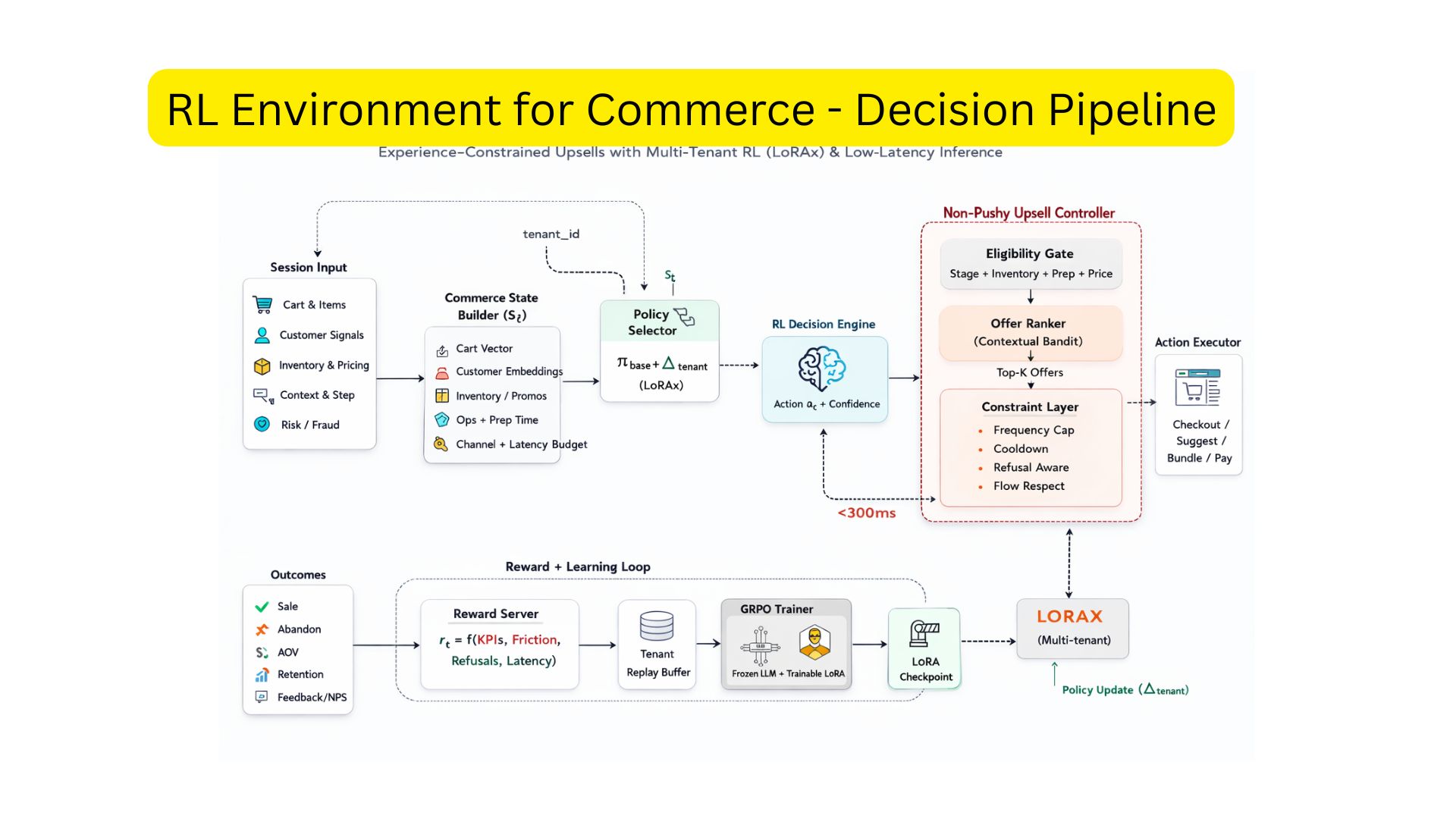
Problem: Taking an order sounds simple. But at scale — thousands of items, live pricing, dietary constraints, and customers who don’t quite know what they want — human order-takers can’t keep up. CommercePlex is a 5-layer agentic commerce architecture where reinforcement learning policies do the heavy lifting: personalizing massive menus, enforcing constraints, and optimizing orders faster and smarter than any manual process.
Just as NVIDIA’s cake (https://blogs.nvidia.com/blog/ai-5-layer-cake/) shows how intelligence is manufactured in real time — with every upper layer depending on the energy, chips, infrastructure, models, and finally delivering economic value in applications — the Commerce Intelligence reference architecture (built by HostBuddy) creates a production-grade stack for Agentic Commerce.
Each merchant gets isolated, real-time, RL-optimized conversational agents that drive upselling and conversions while staying under 300 ms latency and at low marginal cost.
Here is the 5-layer cake, built bottom-up exactly from the capabilities in the CommercePlex reference architecture.
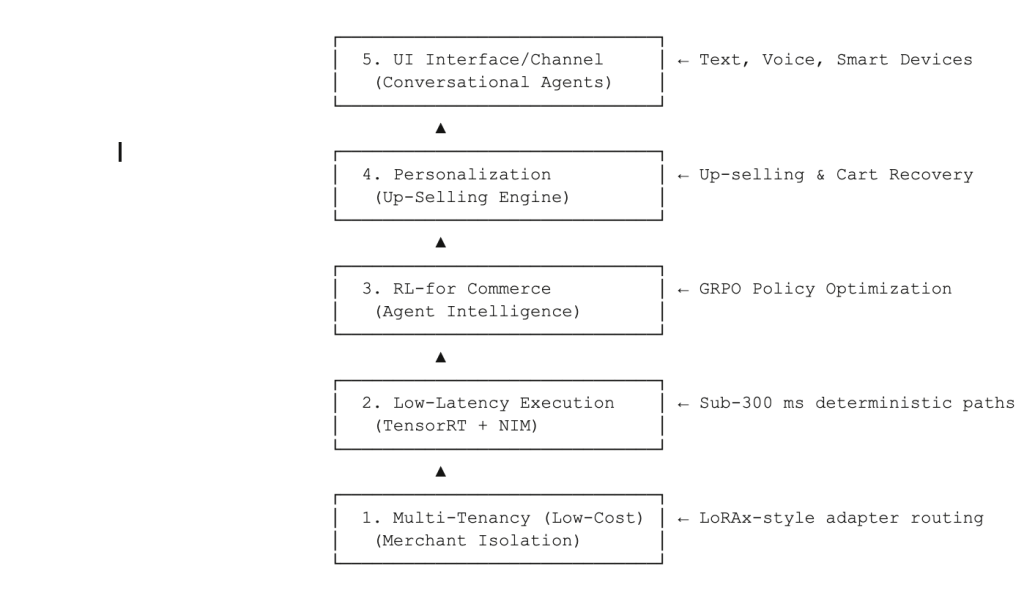
Layer 1 (Foundation): Multi-Tenancy (Low-Cost)
The base layer that makes the entire stack economically viable. Using LoRAx-style adapter routing on NVIDIA AI Enterprise, thousands of merchants share the same base models while each gets its own menu, pricing, promotions, and policies — with strict isolation and no per-merchant model copies. This is exactly how the CommercePlex design achieves massive scale at low marginal cost, turning what would be thousands of expensive fine-tuned models into a single efficient inference farm. Every layer above pulls merchant-specific context from this foundation without breaking isolation or blowing up GPU costs.
Layer 2: Low-Latency Execution
Built directly on the multi-tenant foundation, this layer guarantees sub-300 ms end-to-end responses for live voice ordering, modifier validation, checkout interventions, and cart updates. Deterministic transaction loops are separated from slower reasoning flows and accelerated with TensorRT-LLM and NVIDIA NIM. Without this layer, even perfect RL policies or personalization would be unusable in real customer conversations. The CommercePlex benchmarks explicitly target this latency to match (and beat) human-order-taker speed.
Layer 3: RL-for Commerce
The intelligence core. GRPO (a reinforcement-learning algorithm optimized for commerce) is trained on massive synthetic datasets (Cheesecake Factory menus, Home Depot inventories, interruptions, substitutions, upsell scenarios) to learn optimal policies for combo suggestions, upselling, cross-selling, and cart recovery. These policies are merchant-aware and goal-aligned (maximize conversion, average order value, etc.). This is the “model” layer of the cake — everything below provides the fast, cheap, scalable compute; everything above consumes the decisions this layer produces.
Layer 4: Personalization (Up-Selling)
Sitting on top of the RL engine, this layer injects live session context (current cart, customer history, voice tone, time of day) into the RL policies so every recommendation feels uniquely personalized to that merchant and that customer. It drives the actual up-selling and combo optimization in real time while respecting merchant rules (price floors, inventory, promotions). This is where the generic RL intelligence becomes merchant-specific economic value — exactly as the CommercePlex project plan describes.
Layer 5 (Top): UI Interface/Channel (Text, Voice, Smart Devices)
This exact 5-layer stack is what the CommercePlex reference architecture could be delivered using NVIDIA’s full enterprise stack (DGX Cloud, NeMo for RL, NIM/TensorRT for latency, AI Enterprise for observability and security). It mirrors NVIDIA’s cake, the whole system runs in real time, and the top layer creates measurable business value (conversion lift, higher AOV, lower labor cost).
Conclusion:
CommercePlex is a complete AI stack to commerce: multi-tenant infrastructure for scale, low-cost, low-latency execution for real-time conversations, RL policies that learn what converts, and personalization that turns intelligence into revenue.
The result is conversational agents that can reason over massive menus and inventory in milliseconds — answering requests like “show me kosher options under 800 calories” — can outperform human order-takers.