The Costco Model for Restaurants: A Smarter Path to Predictable Revenue
Most restaurant owners start every day at zero. No guaranteed baseline, no predictable income — just hope that enough customers show up to cover rent, staff, and food costs before the day is done.
Hotels solved this problem decades ago with loyalty programs. SaaS companies built entire business models around monthly subscriptions. Independent restaurants have been stuck with punch cards.
That gap is finally closing — and the owners closing it fastest are borrowing a model from the last place you’d expect: Costco.
Why the traditional restaurant model leaves money on the table
The transactional model — customer comes in, pays, leaves — works fine when tables are full. But it offers no protection when they aren’t. A slow Tuesday, a rainy weekend, a local event pulling foot traffic elsewhere — and suddenly the math doesn’t work.
The solution isn’t more marketing spend. It’s changing the relationship with your most loyal customers from transactional to recurring. That’s exactly what restaurant VIP membership programs are designed to do.
Proof the membership model works
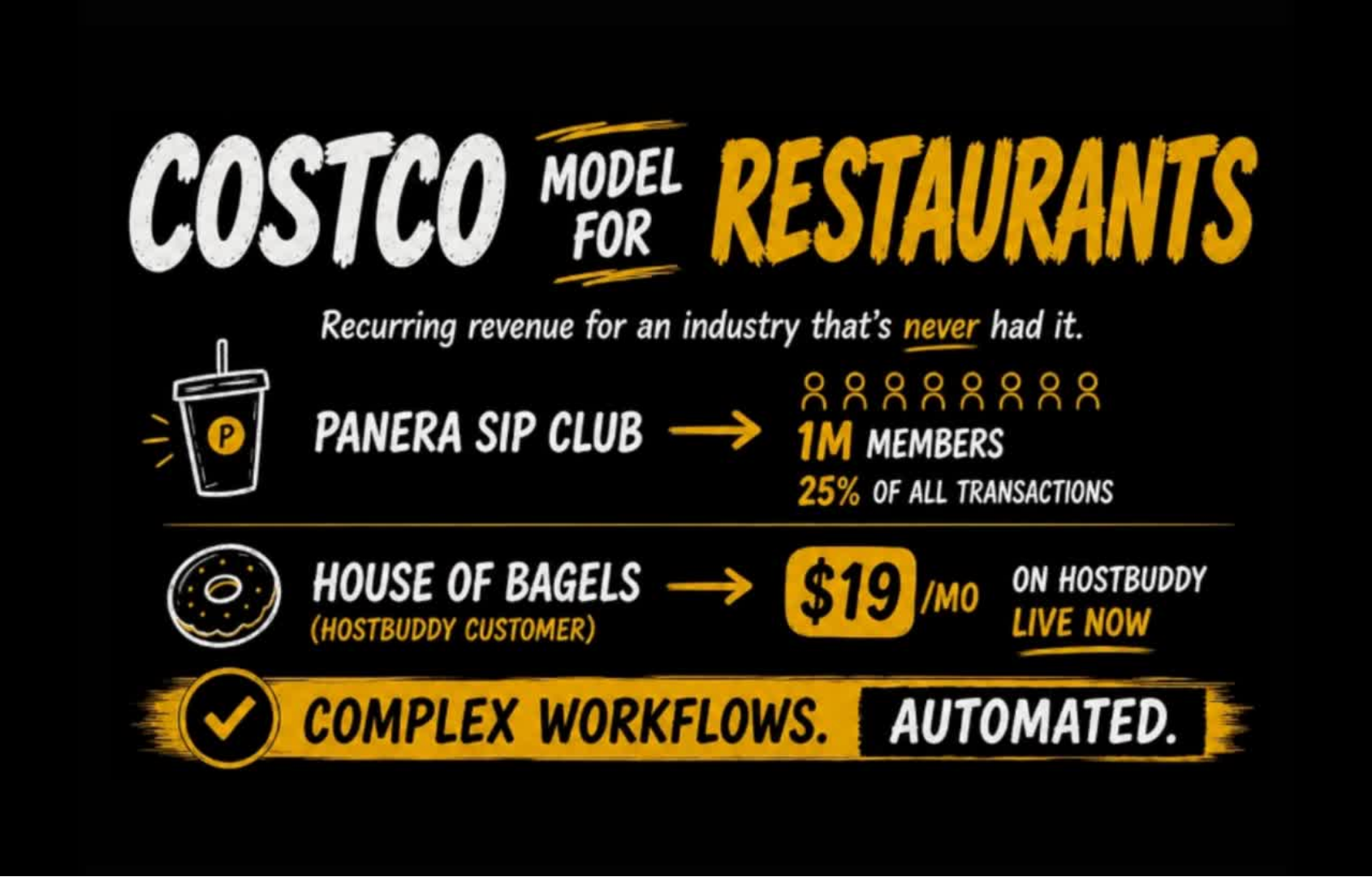
Panera Bread was one of the first to test this at scale. Their “Sip Club” subscription was met with skepticism, but members now account for roughly 25% of all transactions — turning unpredictable weekly revenue into a reliable baseline regardless of foot traffic.
The same logic is now reaching independent operators. Local restaurants are launching their own membership tiers — a flat monthly fee in exchange for perks that make regulars feel genuinely invested. Priority seating on busy nights. A monthly exclusive dish. Early access to events.
The psychology is straightforward: a customer who has already paid $19 upfront doesn’t ask “should I go out tonight?” — they ask “how do I get my money’s worth?”
The operational problem — and how to solve it
Here’s why more independent owners haven’t done this yet: it’s not a lack of motivation, it’s the complexity of running it manually.
Spreadsheets fall apart. Paper lists get lost. Staff-monitored logs create friction at the point of sale. To make the membership model sustainable for a single-location restaurant, the backend has to run itself.
The owners making this work are using AI marketing systems for restaurants that handle the heavy lifting automatically:
- Renewals — processed without chasing payments
- Member recognition — seamless at the point of sale, no awkward check-ins
- Perk notifications — triggered and delivered without manual effort
When the infrastructure handles itself, the operator gets to focus on what actually drives retention — the food and the guest experience.
One question to start with
You don’t need a hundred locations to build a recurring revenue engine. You need a clear offer and a system that doesn’t require babysitting.
Start here: What would make my regulars feel like members, not just customers?
The answer is different for every restaurant. But the commitment — theirs to you, and yours to delivering ongoing value — is what makes the model work long term.
This isn’t a trend. It’s a structural shift toward a more stable, predictable way to run a hospitality business. And for the first time, it’s within reach for independent operators of any size.
Ready to build your membership model?
At HostBuddy, we’ve built tools specifically for independent restaurants — from VIP membership management to AI phone agents that handle reservations and customer queries automatically, so your team can focus on the guest experience.
Book a free demo and we’ll show you exactly how it works for your restaurant.